
Imagine walking into a yoga class and realizing that many of the poses seem surprisingly easy.
Your hands reach the floor. Your hips open deeply. Your knees straighten farther than everyone else’s. Maybe you have always been called flexible, bendy, or naturally good at yoga.
It can feel like an advantage.
But for someone with joint hypermobility, being able to move farther does not necessarily mean the body feels stronger, safer, or more supported.
In fact, the very thing that makes certain yoga poses look effortless can make intentional movement even more important.
This came up recently in a conversation with a local healthcare provider who works with hypermobile patients. We were discussing how yoga can complement other forms of care, and one idea kept surfacing:
For hypermobile people, the goal of yoga often should not be greater flexibility.
It may be learning how to control the mobility they already have.
That shift changes the entire practice.
What Does It Mean to Be Hypermobile?
Joint hypermobility generally means that one or more joints can move beyond the range that is typical for most people.
For some people, this causes no problems at all.
Others may experience joint instability, discomfort, muscle fatigue, recurring strains, or difficulty sensing where their body is in space.
Hypermobility can also be associated with conditions such as hypermobility spectrum disorders and hypermobile Ehlers Danlos syndrome, although being flexible does not automatically mean someone has either condition.
This distinction matters because yoga is often associated with stretching and increasing range of motion.
But when someone already has significant mobility, repeatedly pushing farther into a pose may not be what their body needs.
The Ehlers Danlos Society recommends exercise approaches that emphasize movement control and strengthening the muscles that help stabilize joints. It also cautions against repeatedly stretching beyond a normal range of motion because excessive stretching can contribute to instability. (Ehlers-Danlos Society)
So for a hypermobile yoga student, the question becomes less about:
“How deep can I go?”
And more about:
“How well can I control this movement?”
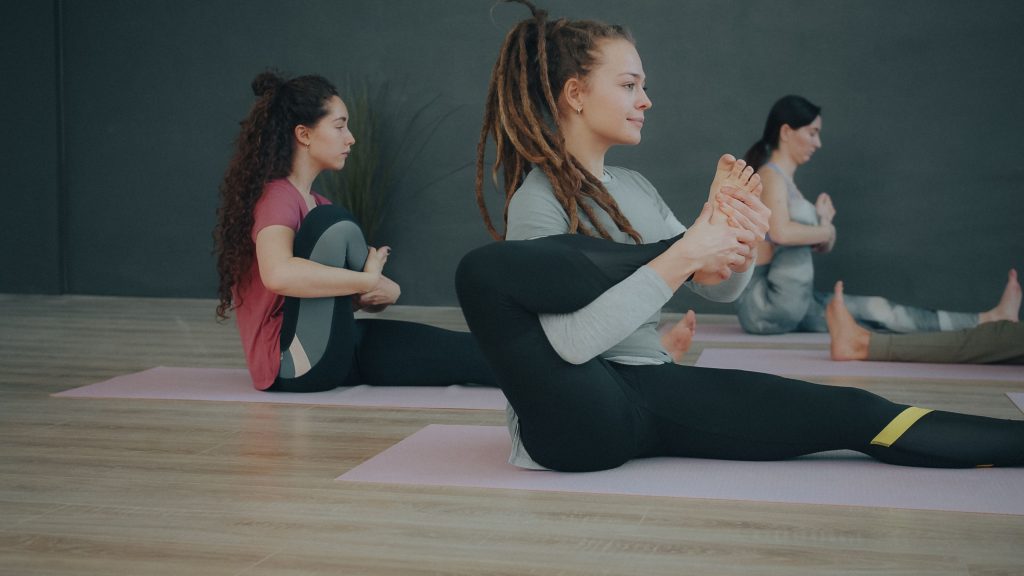
Yoga Can Become a Practice of Stability
A thoughtful yoga practice gives us an opportunity to slow movement down and notice what the body is actually doing.
That can be especially valuable for someone who has spent years relying on flexibility rather than muscular support.
Instead of sinking into the deepest possible version of a pose, a hypermobile student might practice stopping earlier.
Instead of locking the knees in a standing posture, they might maintain a small amount of muscular engagement.
Instead of letting the shoulders collapse into their full range, they might focus on keeping the shoulder joint supported.
These adjustments can make a pose look less dramatic from the outside.
But internally, the body may be doing much more work.

Strength Matters as Much as Flexibility
One of the biggest misconceptions about yoga is that flexibility is the ultimate goal.
It is not.
A sustainable movement practice ideally includes mobility, strength, balance, coordination, breathing, and body awareness.
For hypermobile individuals, strength can be particularly important because muscles help support and stabilize joints.
Current guidance for people with symptomatic hypermobility commonly emphasizes strengthening stabilizing muscles, movement control, and gradually progressing exercise based on the person’s abilities. (Ehlers-Danlos Society)
That may mean spending more time building strength in relatively simple poses rather than constantly progressing toward deeper versions.
Holding a well supported Warrior II may be more valuable than seeing how far the front knee can travel.
Maintaining controlled alignment in a bridge may matter more than lifting the hips as high as possible.
A plank practiced with stability and breath may offer more than a complicated pose that depends primarily on flexibility.
The goal is not to make yoga smaller.
It is to make movement more intentional.
Proprioception: Knowing Where Your Body Is
There is another important piece of the hypermobility conversation that does not get nearly as much attention as flexibility.
Proprioception.
Proprioception is your body’s ability to sense where it is in space without having to look.
Research has found differences in joint position sense among some people with joint hypermobility, particularly in the lower limbs. (PubMed)
That can make detailed movement instruction especially valuable.
For example, someone may think their knee is softly straight when it is actually moving well beyond a neutral position.
They may feel as though their shoulders are stable even while they are hanging heavily into the joint.
They may move into a pose automatically because their body has always been capable of getting there.
A teacher who offers clear verbal cues, visual feedback, props, and personalized adjustments can help a student develop a more accurate sense of how their body is moving.
Over time, yoga can become less about performing shapes and more about developing awareness.
Why Stretching Is Not Always the Answer
Hypermobile people can absolutely experience tightness.
This is where things can feel confusing.
Someone may be very flexible and still constantly feel tight.
That sensation can create an urge to stretch more and more.
But sometimes a muscle may feel tight because it is working hard to help stabilize a joint.
In those situations, continually stretching the area may not address what is actually happening.
Guidance from The Ehlers Danlos Society specifically notes that some people with hypermobility feel they need to stretch even when the sensation may be related to overworked or overactive muscles. Their recommendations emphasize careful stretching and avoiding overstretching beyond a normal range of motion. (Ehlers-Danlos Society)
This is one reason individualized movement can be so helpful.
The answer is not simply “never stretch.”
The better question is:
What does this particular body need right now?
Breath Changes the Practice Too

Yoga offers something that many traditional exercise programs do not emphasize as strongly.
Breath awareness.
When we slow the breath, we naturally slow the movement.
That gives us more time to notice compensation patterns.
Are you holding your breath when a movement becomes challenging?
Are your ribs flaring to create the appearance of greater range?
Are your shoulders gripping?
Are you collapsing into a joint rather than using the surrounding muscles?
Breathing creates a pause between simply getting into a position and actually experiencing how you got there.
For many students, that awareness is where the practice becomes useful far beyond the yoga mat.
One Pattern We See Again and Again
One pattern our team sees again and again is that the people who appear the most flexible are not necessarily the people who need more stretching.
Sometimes they need more strength.
Sometimes they need more control.
Sometimes they simply need permission not to go as far.
In a group yoga setting, it can be tempting to look around the room and assume that the deepest expression of the pose is the most advanced.
We see it differently.
The most advanced version of a pose may be the version in which you can breathe comfortably, maintain control, and understand exactly what your body is doing.
For a hypermobile student, backing out of a pose can actually require more awareness and strength than moving farther into it.
That is a very different definition of progress.
Why Personalized Yoga Can Be Especially Helpful

No two hypermobile bodies are exactly alike.
One person may have significant mobility in their shoulders but relatively typical mobility elsewhere.
Another may primarily notice instability around the knees or hips.
Someone else may have been diagnosed with a hypermobility related condition and already be working with a chiropractor, physical therapist, physician, or other healthcare provider.
That is why individualized yoga can be valuable.
Rather than following the same sequence as everyone else in a crowded room, private yoga allows the practice to respond to the person in front of the teacher.
We can slow down.
We can modify poses.
We can use props.
We can spend more time on strength and stability.
We can pay closer attention to breathing and alignment.
And when someone is already receiving care for pain, instability, or a diagnosed condition, yoga can be adapted as part of a broader wellness approach in communication with their healthcare team.
Yoga should complement appropriate medical care, not replace it.
Five Ways to Make Yoga More Supportive for a Hypermobile Body
1. Stop Before Your Maximum Range
➻ You do not need to move as far as your body possibly can.
➻ Experiment with staying somewhere in the middle of your available range and notice how much more muscular effort may be required.
2. Focus on Control
➻ Move slowly enough that you can feel how you enter and exit each pose.
➻ The transition matters just as much as the final shape.
3. Build Strength Around Mobile Joints
➻ Think about creating support around areas that tend to move easily.
➻ A qualified instructor can help you identify ways to use muscular engagement rather than relying entirely on joint range.
4. Avoid Locking Into Joints
➻ Pay attention to elbows, knees, shoulders, and other areas where you may naturally move toward an extreme position.
➻ Learning what a more supported position feels like can take practice.
5. Work With Someone Who Understands Your Body
➻ If you experience pain, repeated injuries, significant instability, or have a diagnosed hypermobility related condition, talk with an appropriate healthcare professional about what types of movement are suitable for you.
➻ Then look for a yoga teacher who is comfortable adapting the practice around those needs.
How Vibrant Yoga Can Help
If you are looking for personalized support, our private in home yoga sessions are designed around you, your body, your goals, your schedule, and your experience level.
Instead of trying to fit your body into a predetermined yoga class, your instructor can build the practice around the way you move.
For hypermobile students, that may mean focusing less on increasing flexibility and more on stability, strength, balance, breath, and body awareness.
Whether you are looking to reduce stress, improve mobility, build strength, increase balance, or simply feel better in your body, we bring personalized yoga directly to your home.
No commuting.
No crowded studios.
Just individualized support designed to help you move and feel your best.
Supporting employee wellbeing does not have to be complicated.
We partner with organizations throughout Chicagoland to bring wellness directly into the workplace through yoga, chair yoga, meditation, breathwork, sound meditation, chair massage, and educational wellness workshops.
Whether you are planning a wellness event or building a broader employee wellbeing strategy, our goal is to make movement and wellness approachable for different bodies, abilities, and experience levels.
A Final Thought
Being able to move farther is not always the same as moving better.
For someone with hypermobility, yoga can become an opportunity to change the goal entirely.
Less chasing flexibility.
More developing strength.
More awareness.
More control.
More understanding of how your individual body moves.
Sometimes progress is not reaching farther.
Sometimes progress is learning exactly where to stop.
Frequently Asked Questions
- Is yoga good for people with hypermobility?
- Yoga may be appropriate for some people with hypermobility when the practice is adapted to their individual needs. A supportive practice may emphasize strength, movement control, stability, and body awareness rather than repeatedly increasing range of motion. People experiencing pain, instability, frequent injuries, or a diagnosed hypermobility related condition should discuss exercise with an appropriate healthcare professional.
- Should hypermobile people avoid stretching?
- Not necessarily. Gentle, targeted stretching may still be appropriate for some people, especially when particular muscles are tight. However, repeatedly pushing joints beyond a typical range may increase instability for some hypermobile individuals. The appropriate approach depends on the person.
- Can yoga improve proprioception?
- Yoga involves slow movement, balance, body awareness, and attention to joint positioning, all of which can create opportunities to practice proprioceptive awareness. Research has found proprioceptive differences in some populations with joint hypermobility, which makes careful movement awareness particularly relevant. (PubMed)
- What type of yoga is best for hypermobility?
- There is no single yoga style that is best for every hypermobile person. The instructor’s approach may matter more than the label of the class. Look for teaching that emphasizes control, strength, alignment, gradual progression, and individualized modifications rather than extreme flexibility.
- Is private yoga helpful for hypermobile beginners?
- Private instruction can make it easier to adapt yoga to a person’s mobility, strength, comfort level, goals, and existing healthcare recommendations. It can also give the instructor more opportunity to observe movement patterns and provide individualized feedback.
Vibrant Yoga brings personalized wellness experiences directly to individuals, workplaces, and communities across Chicagoland—and virtually anywhere. We offer private in-home yoga, corporate wellness programs, meditation, chair massage, sound meditation, and educational workshops designed to help people move better, feel better, and live healthier lives. We envision a world where every individual and organization has the opportunity to make wellness a sustainable part of everyday life.